Some notes on Psalm 12

Random Image

Praise the Lord for he cares for our concern.

About the Psalm


Psalm 12 presents a horrific reality: the decreasing number of faithful people of God. It is a horrific situation because faithful people might have been distracted by other interests and ambitions that gradually and finally took over their commitment. When Jesus came to us, he explained this phenomenon using a “good soil” metaphor (recorded in Matthew 13). Jesus explained that faithful people might have had a good start in the new life, but they had not fully grasped the promises of God and so could not withstand other distractions.

There will be many reasons people begin to move away from God: even if they intended the move to be physical but not spiritual, in almost all cases, not coming to church and worshipping together means there is no faith in that person.

Yes, churches are full of people who don’t get on well with others, and many decided not to attend church at all because that is “religion” than “faith”. The irony is that we are referring the comment to ourselves; secondly, the lone faith seeker needs growth somewhere with a community. The only way to ensure they have spiritual growth is they are part of the leadership. In that sense, the issue is not about “religion” or “faith”, it is about control.

How true is the description above? Well, probably very true. More so, what’s the point of this psalm? Jesus also said something else when he came to us: we can have many interests and commitments, but ultimately there is only one we will commit to, above all else. That means everything else falls in their place because of this one commitment.

This commitment is so important that every other thing has to adapt and adjust the way we spend time with them. Jesus illustrated by saying we can choose either God or money (recorded in Matthew 6). Of all humanity, who has proven that they are faithful to both God and their ambition? I still think that is not the issue; the real issue is that we thrive in being the wrong kind of soil that recognises the right kind of seed. We cannot be faithful to the seed; the seed does not grow well.

biebel-761019_1280

It might be worth pointing out that many say the “process” is more important than the “outcome”. Specifically, when undertaking an activity, we learn more about something and about ourselves than we do from attaining the outcome. That might be a good metaphor: many of us thrive or are happier venturing out and talking about our struggles with faith (going to church, worshipping God) than actually doing something about the faith (a relationship with God). In this context, talking or meditating about our balancing act between God and other distractions does not get us anywhere. Fundamentally, we can keep talking about the situation. Or we can be faithful to God.

Is that relevant to Psalm 12? Look at verse 3 and onwards. What do the unfaithful people say and do, to themselves and to those remaining faithful to God?

Why does the psalmist say God’s words (and promises) are like silver that has been refined in a furnace? It is a very odd thing to say, very out of place, and short of saying God is God when his words need “refinement”. God’s words have not been given in isolation; they are in context and relevant to place and time, and to the people therein. His words being refined is about his interaction with his people.

About the music

This is the second psalm in multiple languages. I began with a desire for a psalm that had the potential for singing in multiple languages – of course, all the psalms can be done that way since they are translated into many, many languages. For me, for this occasion, I wanted a psalm that is relatively “short”, and the structure of the phrases are close enough between the languages. Psalm 12 was one I worked on some time ago when I set up the study questions. It is “short” enough, has a clear theme, and the structure of the phrases are near enough.

For this time, I wanted to start working on the text in multiple languages before considering the music setting. This tests my initial hunch that this is a good choice for setting the multiple languages to music. It also gives me a step further into the psalm: meditating on it in several languages gives tremendous depth to God speaking to us today.

I set up a table, part of it shown below, where I can see the verses of the languages easily. At this stage, I want to use Chinese and Malay along with English. I want to extend to one or two other languages, e.g. French, Punjabi, but I can get to that later.

In the table, the left side column is the verse number, 1a is first part of verse 1, followed by 1a etc. The second column is the text in Chinese, and the third column is the number of characters in that line of text. The next two columns are for the text in Malay, and the number of syllables. The last two columns are the English text and the number of syllables there.
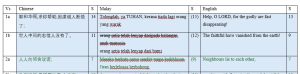
Lyrics table, Psalms 12

Lyrics table, Psalms 12

Nothing too controversial here! What comes next is a deeply reflective and prayerful exercise. I want each line of text to have about the same number of syllables/characters. Why? The music will be set for the text: there is only one musical melody for all the text in different languages. The music should not sound as if it is written for one language, and the other languages have to “fit in”. The music should be as “authentic” to the text as possible.

But it is important to note that this process is meant to engage further with the text rather than to match syllables. This process is part of composition. Both the music and the text are being “forged” into a unified whole. The music is being “birthed” into an identity that works well, or not so well, with the text. The text ought to slide and shift to go well with the rise and fall, and beat of the music. In this process is a stir-fry of the two main elements where each individual lines and dots is as important as any other. This creates a musical intention that goes well with the text.

One detail here is that some languages have tonal or linguistic characteristics that are part of the communicative device. Of the three languages above, English is the most sensitive to this. For example, the emphasis for the word “music” is “mu”, rather than “sic”: setting “mu” on a stronger beat is a good idea compared to “sic” which should be on a weaker beat. Other factors will come into play such as the rhythm, duration of the notes, etc. in such a way that sometimes we find that adhering to the stresses is not that important.

Comparing English language to Chinese, the latter has characteristics such that the characters will convey their meaning irrespective of the stresses and beats of the music. Emphasis of meaning is borne during speaking where characters will be stressed where we want added attention. So long the sequence of characters are acceptable in a singing context, it will be fine. For example, “the love of God is special” and “the love God is special” bears the same meaning.

flower-6086288_1280

Of the three languages, Malay has the most challenges because of the use of prefixes and suffixes for a word, whether verb or noun. For example, “lihat” is the root word for “to look at” or “to see”. It can have a prefix “me” to infer the action of looking. It can also have both prefix “ke” and suffix “an”, “kelihatan”, which means visual appearance or outlook. An example is “mereka kelihatan gembira”, which means “they (mereka) look (kelihatan) happy (gembira)”.

Going further, in the singing context, it is acceptable to drop some of the prefixes and suffixes so long the meaning is retained. Meaning can be retained by the sequence of the words too. In the table above, some of the the original translation of the Malay text has been crossed out, when I worked out an alternative (shorter) version of the text.

What happened with setting the text to music, on this occasion, was I first set up the table for the first three verses in the three languages, along with the count of syllables/characters. Then, I began setting it to music. Why I did this was because there will be fine adjustments that cannot be predicted in the exercise in Table 1. Moving to the music gives me a grounding on the music, or the first version, which can help in sorting out the syllables in the remaining verses.

Writing the music was not too difficult, I aimed to write phrases that are relatively singable. I decided to try the key of D, thinking that the highest notes would be D or E, or even F# if needed. I also wanted a music that sounds positive; even though the text is about struggles and hardships, sometimes, having the music in a positive spirit helps convey how faith, where we “should be” rather than the condition we are in.

In the first version of the hymn, my first verse begins from verse 1 and ends in verse 3. To continue verse 2 will start verse 4. Doing this, the text will be very abrupt and can sound disjointed – when we had completed verse 1, we might not remember what was sung at the end which is verse 3. I thought “long and hard” about this, and decided to use a repeating device, and give myself the chance to recall the title of the music. What I did was to drop verse 3 from the first verse, and replace that using the first two lines of verse 6: “The Lord’s promise is pure, like silver refined in a furnace.” The plan is that each verse will end with this line of text. At this stage, it looks like the hymn will grow from 3 verses to 4.

At this stage I had spent about 4 hours. I foresaw I would need another 4 hours to set the remaining text for the two languages to the verse; I expected some further minor adjustment (to the text of the remaining verses and the music). But I would hum and play through the music many times over to check that it was ok, before moving on to other verses.

Another 20 hours later, the music setting with lyrics is done. I adjusted the melodies further to account for the languages, choral and harmonic flow. Another 4 of that was testing out different ways to lay out the multiple languages in the score. With four verses, it is going to be impossible to hold two, if not all, languages on one page. The next best option was first to have the English version lyrics (with music), and then add the first verse of each of Malay and Chinese to it. And then, the Malay one has the four verses in Malay, and the full set of English text in smaller print within the music. This was then repeated for the Chinese version, and etc.

A paraphrase

Lord, are we the only one left?
All those at gathered worship, we can count in two hands!
Lies and cheats everywhere,
They mislead right in front of you, their deception clear as broad daylight.
Lord, consider cutting off their flattering lips,
Tighten up their tongues so they cease their voice:
Saying “We do what we want,
What else do you want to control us with, you can’t stop our lips!”

God says in response, “I grieve about the violence everywhere,
their complaints and dying breaths I have heard.
I have appointed this as the best time to act and rescue my people
to fulfil my covenant with them to protect and save them.”
God’s promises are like silver
So pure as if it’s been refined hundreds of times through the ages.
Because of this, we have faith that God will protect
those who suffer and are snuffed out from the broods of liars,
as they continue to puff up their emptiness,
and their wicked deeds are praised by those trapped.